
Franciszek Kamiński is the patron of the Kielce Główne station.





Franciszek Kamiński, the creator and commander-in-chief of the Peasant Battalions, organizer of the peasant resistance movement in the Kielce region, an officer of the Home Army, repressed by the communist authorities after the war, and a knight of the Order of the White Eagle, has become the patron of the Kielce Główne railway station.
The ceremony of naming Kielce Główne station after Franciszek Kamiński will take place on April 27th in front of the station building, where a commemorative plaque dedicated to the patron will be unveiled. The event will be attended by, among others, Władysław Kosiniak-Kamysz, Deputy Prime Minister and Minister of National Defence, Dariusz Klimczak, Minister of Infrastructure, Alan Beroud, President of the Management Board of PKP S.A. and PKP Group, and Dariusz Grajda, Vice-President of the Management Board of PKP S.A., as well as representatives of social, cultural, and public administration circles. The ceremony will be accompanied by an honor guard from the Polish Army and the Railway Protection Guard.
– During World War II, the People's Movement was one of the pillars of the Polish Underground State, and the Peasant Battalions were the second largest military force in occupied Poland, after the Home Army. Approximately 170,000 soldiers were involved in the fight, carrying out about 3,000 various combat operations. It is important to remember their courage and sacrifice, as the memory of heroes builds our future. Today in Kielce, we honor the memory of one of the bravest of our nation, who was not afraid to fight for his homeland and his loved ones, and who did not succumb to repression. – emphasized Władysław Kosiniak-Kamysz, Deputy Prime Minister and Minister of National Defence.
– Naming the Kielce Główne station fits in with this year's anniversaries of 100 years of PKP and 200 years of railways in the world. Today's event proves that we skillfully combine tradition and the preservation of history with a modern approach to infrastructure development. The building of the Kielce station has recently undergone thorough modernization and has become a 21st-century facility, making it a showcase for the city. And this is not the only investment of its kind in the Świętokrzyskie Voivodeship, as we are planning more in the region. The implementation of railway projects in both large cities and smaller towns shows that the Ministry of Infrastructure and PKP have a cohesive, well-planned program for individual regions and the entire country. – said Dariusz Klimczak, Minister of Infrastructure.
Franciszek Kaminski is a participant in the struggle for an independent Poland. He was born on September 20, 1902, in Mikułowice in the Kielce region. After the outbreak of World War II, already in the first weeks of the German occupation, he was one of the co-founders of the central center of the peasant movement in the Warsaw area. In November 1939, he began work on creating a peasant resistance movement in Kielce region. At his inspiration, the first underground cells of the Peasant Party „Roch” were established in the Pińczów, Opatów, Sandomierz and Ilzec districts. In mid-August 1940, Kaminski put forward the idea of forming a Peasant Guard (the organization later took the name of the Peasant Battalions), and headed it. In October 1940 Kaminski was appointed Commander-in-Chief of this first independent peasant armed organization in the history of Poland. In 1944. Franciszek Kaminski became a member of the High Command of the Home Army. He also fought in the Warsaw Uprising. After the war, he spent more than six years in a secret police prison. In 1989 he reactivated the PSL and became its president, and a year later accepted the title of honorary president. He died on February 24, 2000 in Warsaw.
– The Year of Polish Railways is an excellent time to show how railways connect our history with modernity. Today's ceremony is taking place at the railway station modernized by PKP S.A., which is modern and adapted to the needs of all travelers. This is the main railway station in the region's capital, serving over 8,000 passengers daily. Naming this important facility after the commander of the Peasant Battalions is an expression of our memory and deep respect for Franciszek Kamiński. – emphasizes Alan Beroud, Chairman of the Management Board of PKP S.A. and the PKP Group.
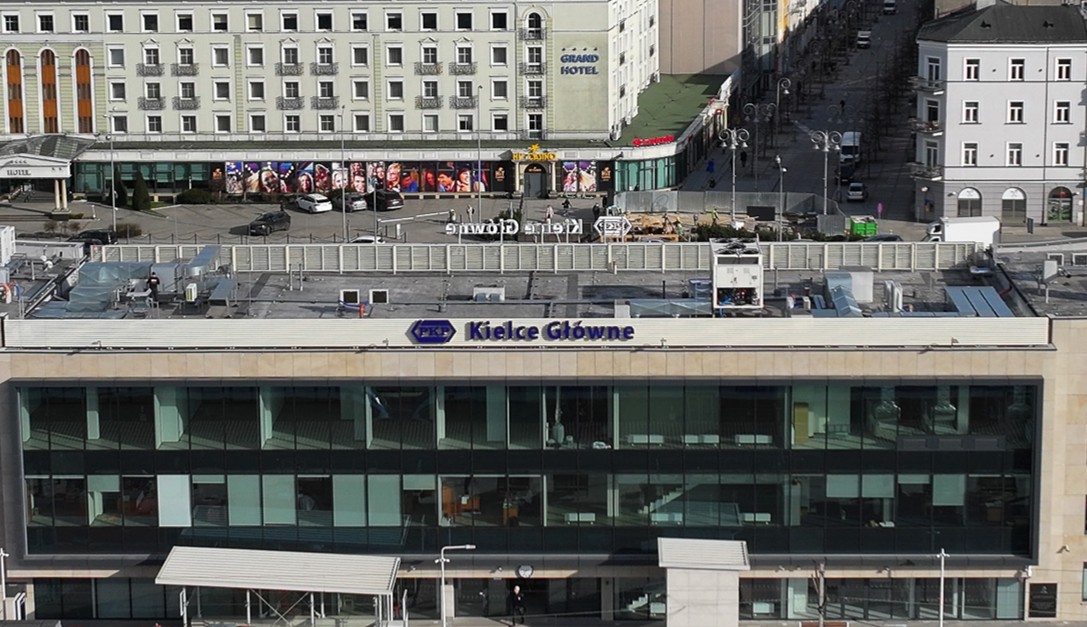
Kielce Main railway station is a modern facility, with a comfortable and functionally arranged interior, which underwent a comprehensive reconstruction with European funding from the Operational Program Infrastructure and Environment. The investment took nearly two years and was completed at the end of 2023. During the work, the body of the modernist - dating from 1965-1971 station was preserved, while its appearance and interior underwent a huge metamorphosis. The central façade was completely glazed, while the building's wings were finished with glass and sandstone. The space for serving travelers was concentrated around the 500-square-meter lobby. On the first floor, in addition to the lobby, travelers will find ticket offices, restrooms and commercial premises. The building is also developed through cooperation with the local government - almost 800 sq m on the second floor of the building is occupied by the Public Transport Authority. The station has been fully adapted to the needs of people with disabilities. It is equipped with energy-efficient lighting, an intelligent building management system responsible for, among other things, optimizing electricity, heat and water consumption, as well as photovoltaic panels for obtaining „green energy.” The safety of passengers is watched over by modern monitoring and fire protection systems. The area near the south wing of the station also underwent a metamorphosis. A small parking lot has been created there, as well as a bicycle shelter, and elements of small architecture have been installed: benches, garbage cans, lamps. Green areas have also been newly arranged.
Kielce Główne is the 21st train station to receive its patron in the program of naming selected stations after outstanding Poles, implemented by PKP S.A. Stations such as Kraków Główny, Warszawa Centralna, Gdańsk Główny, Olsztyn Główny, Szymankowo, and Tarnów also have their patrons.